
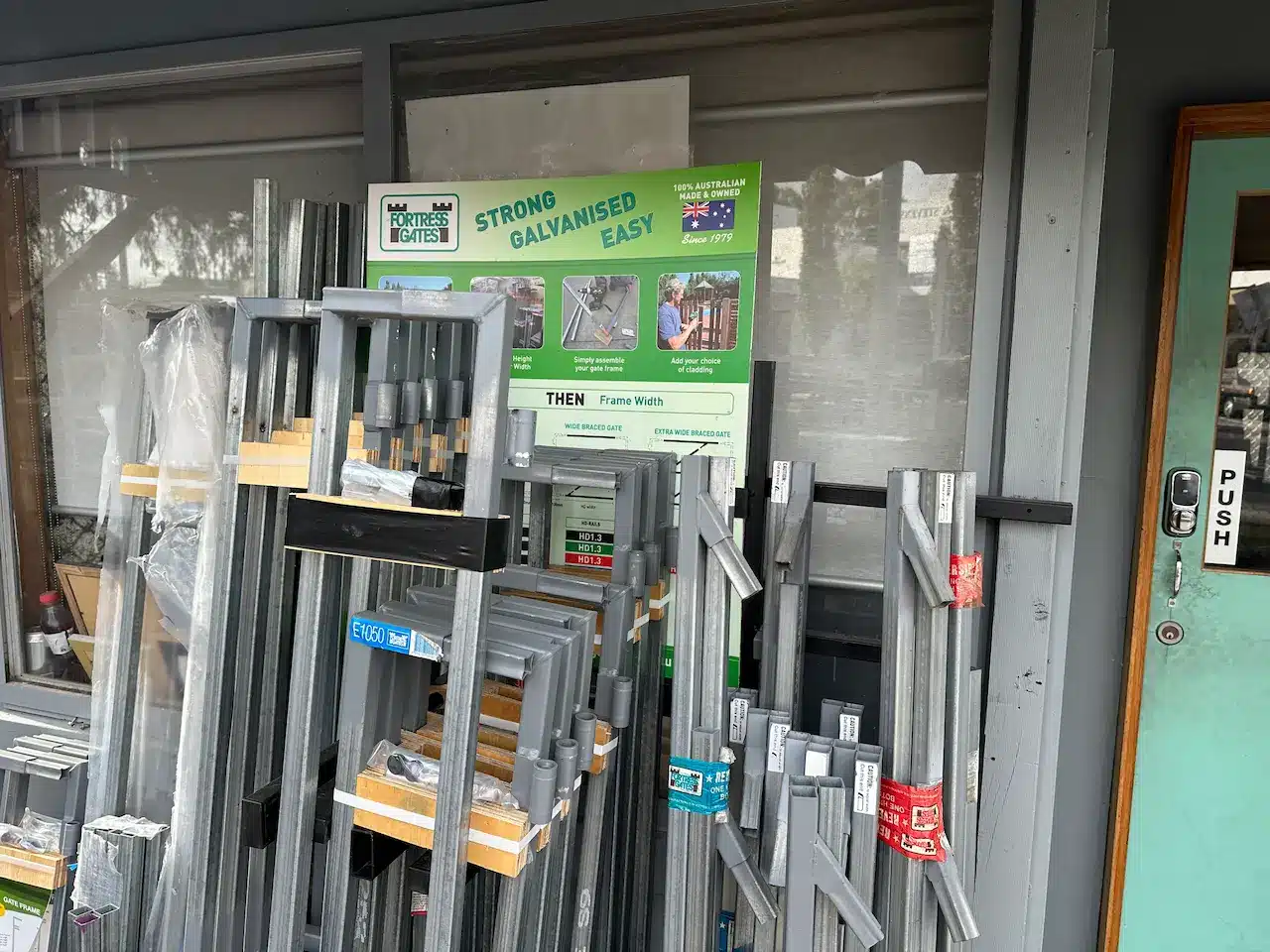
Fortress gate kits are modular galvanised steel gate frames you assemble and clad in timber, composite or sheeting. Paint-ready and made for DIYers.
Fortress gate kits let you build a steel-framed gate to your own width and clad it in timber, composite or sheeting. The frames are galvanised steel, come paint-ready and are designed for a DIYer to put together, and Fortress describes itself as a preferred supplier for professionals. We supply them from our Watsonia yard along with the timber to clad them.
Fortress has been in business since 1979, and its patented system works like puzzle pieces. A gate is built from three kinds of part:
Self-drilling screws to lock the frame together are supplied. Lay one side on firm ground, slide the rails on, tap them home with a mallet or a block of wood (never a metal hammer), bump the other side into place and screw it off.
| Part | Code | Size |
|---|---|---|
| Vertical gate panels | E1050 | 1050mm high |
| Vertical gate panels | E1400 | 1400mm high |
| Vertical gate panels | E1650 | 1650mm high |
| Vertical gate panels | E1850 | 1850mm high |
| Connecting rail | CR1.0 | 1000mm long |
| Connecting rail | CR1.3 | 1300mm long |
| Connecting rail | CR1.6 | 1600mm long |
| Connecting rail | CR2.0 | 2000mm long |
According to Fortress, the widest single gate the system makes is 2.1 metres and the widest double gate 4.2 metres, using two of its HDD1.9 products. Ask us which sizes are on hand before you plan the opening.
Frames wider than 1.2m generally need a diagonal brace, running from the latch side down to the bottom hinge. Some claddings, such as Colorbond steel sheeting, act as a brace once they’re fixed. On HD-labelled products about 300mm can be cut from the width, but only on the latch side.
Fortress welds Australian-made, heavy-duty ball bearing hinges onto its frames. They’re reversible, so the gate can hang from the left or right post, and they fix to the front or back of the post for a swing of up to 180 degrees. Hinge screws aren’t supplied because they depend on your post, and latches are sold separately so you can choose one that suits. Fortress recommends at least 125 x 125mm cypress pine or 75 x 75 x 3mm steel posts.
Leave 5 to 10mm between the gate and post for the hinges, 10 to 15mm where a pair of gates meet, and about 50mm underneath on level ground.
The frames come unpainted so you can pick your own colour. Check with a paint specialist first, as not every paint suits galvanised steel. To clad, drill through the timber only, then drive the screw through that hole into the steel frame. Our timber cladding boards and WoodEvo composite battens both give a clean finish. We reckon a horizontal slat gate on a Fortress frame is about the easiest way to match a new slat fence.
Fortress frames and cladding are delivered by our own trucks across Melbourne, or collect from the Watsonia yard; call us for a delivery price. Send us the opening width and the cladding you have in mind and we’ll work out the parts list. Call (03) 9435 2555 or use our online quote request. The Fortress gate frame installation guide is worth a read before you start.
25 x 25 x 1.6mm Australian steel tubing, galvanised inside and outside to protect against rust.
No. Latches and the screws that fix the hinges to your posts are bought separately.
Usually for frames wider than 1.2m, though it depends on the cladding you use.
Yes. Frames are left unpainted; check with a paint specialist for a product that suits galvanised steel.